

Is a hair transplant painful? The part you are most likely to notice is the local anaesthetic injections, which cause brief discomfort before the scalp goes numb. Afterwards, the NHS says a tight, achy and swollen scalp for a few days is common. Nobody can promise you will feel nothing, and people differ, so this guide sets out what you may feel at each stage and how long it tends to last.
At Clinic Center, with our head office in Bermondsey, London, we carry out procedures under local anaesthetic, and you stay awake, with breaks for food and rest. Our aim here is to give you a straight answer before you book.
Key takeaways
- In one study of 128 scalp procedure patients, manual local anaesthetic injections scored an average of 4.30 out of 10 for pain.
- The NHS says the scalp is commonly tight, achy and swollen for a few days after a hair transplant.
- The International Society of Hair Restoration Surgery (ISHRS) says discomfort typically lasts a day or two, followed by 7 to 10 days of tenderness to the touch.
- Severe pain or unexpected symptoms are not something to sit out: the NHS says to contact your clinic as soon as possible.
How painful is a hair transplant at each stage?
A hair transplant usually involves brief discomfort from the injections, a numb scalp during the procedure, then soreness and tenderness that settle over days. The table brings the stages together, with timings from the NHS, the ISHRS and our own treatment pages.
| Stage | What you may feel | Typical duration |
|---|---|---|
| Local anaesthetic injections | Brief discomfort | Usually around five minutes |
| Extraction and implantation | Numb scalp, awake throughout | 5 to 7 hours for DHI, 6 to 8 hours for Sapphire FUE |
| First few days | Tight, achy, swollen scalp | A few days |
| First one to two weeks | Tenderness to the touch | 7 to 10 days, after a day or two of discomfort |
| Numbness | Reduced feeling in parts of the scalp | Usually 2 to 3 days, settling within a week |
| Scabbing and itching | Tiny scabs, mild itching | Scabs clear in 10 to 14 days |
Your own experience may differ, because anaesthetic technique, graft numbers and sensitivity all vary.
Does the local anaesthetic hurt?
Yes, the local anaesthetic injections can hurt for a short time. A 2025 study in Plastic and Reconstructive Surgery Global Open looked at 128 patients, 85 of them having a hair transplant and 43 having scalp micropigmentation. Manual injections scored an average of 4.30 out of 10 for pain, and an electronic constant-speed injector scored 2.63.
Those figures describe the injections, not the whole procedure, and come from one study. They do show that how anaesthetic is delivered can change how it feels, so it is fair to ask any clinic how it gives the injections and what it does for people who dread needles. The ISHRS notes that some patients are given a numbing agent on the skin beforehand.
Does hair transplant surgery hurt once your scalp is numb?
Hair transplant surgery should not feel sharply painful once the local anaesthetic has worked, because the treated areas of the scalp are numbed. You are awake, though, and a long session can be tiring even when the scalp is numb. If you feel anything sharp, say so straight away so the team can check the numbing.
Our Sapphire FUE hair transplant typically takes 6 to 8 hours, and a DHI procedure usually takes 5 to 7 hours. We build in breaks for food and rest.
Can I be sedated for a hair transplant?
Not at Clinic Center. We do not offer sedation, because it is generally not necessary: your procedure is done under local anaesthetic, and you stay awake and comfortable throughout. Some clinics do offer sedation, and the NHS describes hair transplants as usually done under local anaesthetic plus sedation. The ISHRS says general anaesthetic, which makes you completely unconscious, is rarely used.
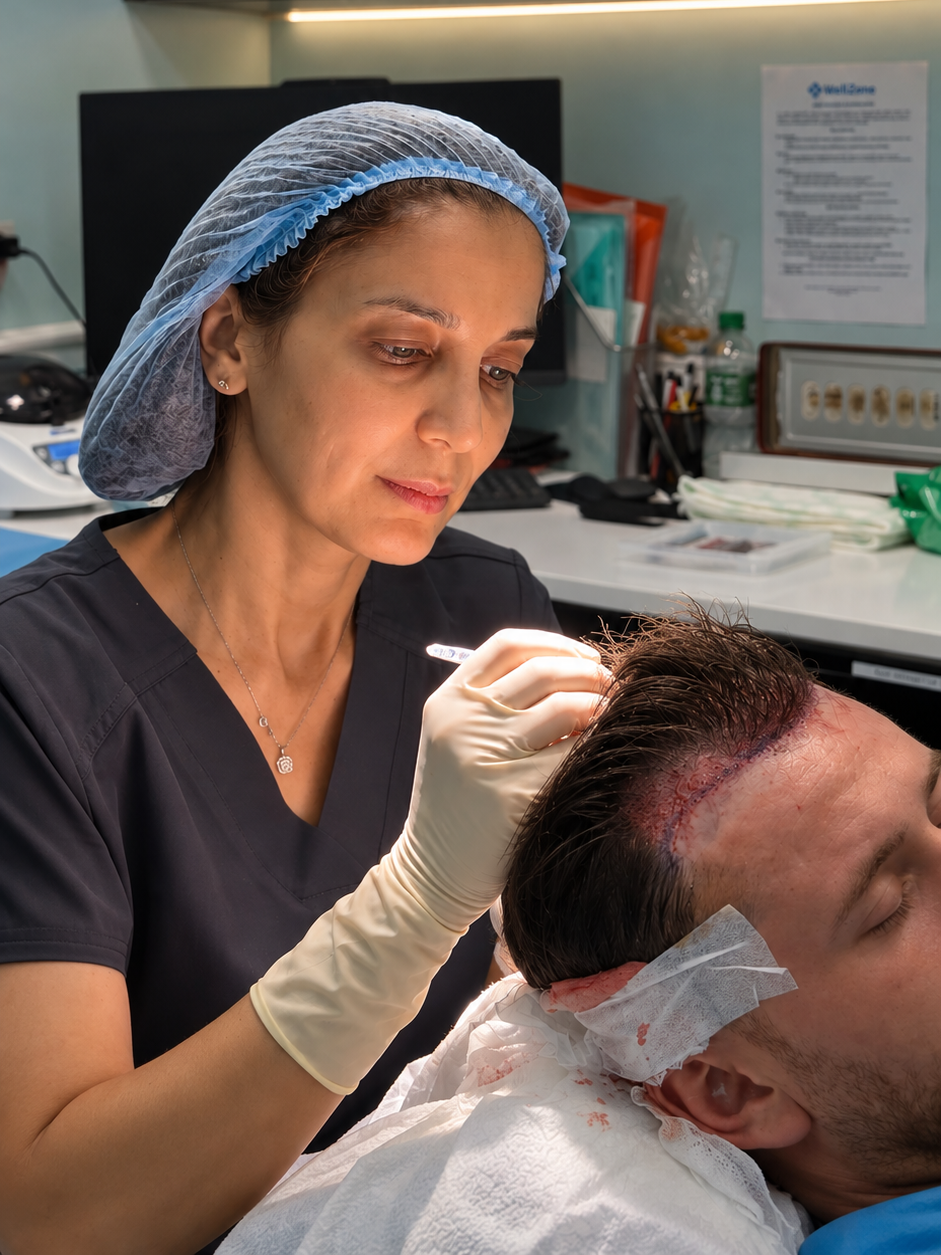
Dr Songul, hair transplant surgeon at Clinic Center London, said: “The local anaesthetic injections usually take around five minutes. There is some discomfort then, but once the area is numb, the rest of the procedure is generally painless.”
As the anaesthetic wears off, you may feel mild discomfort or tenderness, which is usually manageable. If you are particularly anxious, anti-anxiety medication may be an option, depending on your medical history and needs. We assess this at your consultation and, if it is appropriate and safe, our doctors prescribe and give it under medical supervision.
How long does pain last after a hair transplant?
Pain after a hair transplant usually fades within days, with tenderness lasting a little longer. The ISHRS says most patients report no more than mild discomfort, typically for no longer than a day or two, then 7 to 10 days of tenderness to the touch. The NHS describes a tight, achy and swollen scalp for a few days.
Most people describe those days as tightness or tenderness rather than pain, managed with standard painkillers, and our aftercare includes a written recovery plan. Tiny scabs form where the grafts were placed and clear in about 10 to 14 days. Our hair growth timeline covers what happens next.
Example: you work at a desk and have a Sapphire FUE procedure on a Friday. Most people return to desk work within three to five days, so Monday may feel early and midweek is more realistic. The NHS says you may need 1 to 2 weeks off, so a full week is a sensible plan if you can arrange it, and more if you want scabs to clear first. This scenario is illustrative, and your doctor should advise on your own recovery.
Is FUE or DHI less painful than FUT?
FUE appears to cause less pain afterwards than FUT, the strip method, according to the evidence we found. A 2019 Archives of Plastic Surgery study of 241 patients found significantly less severe pain after FUE, with minimal pain on day one, while pain after FUT had almost gone by day three. Only 39 of those patients had FUE, and the study looked back at existing records.
We found no independent study comparing pain between Sapphire FUE, DHI and standard FUE, so pain alone is not a good reason to choose between them. Choose on your hair loss, your donor area and your doctor’s advice.
What are the downsides of a hair transplant?
The main downsides of a hair transplant go beyond soreness: time off, temporary scabbing and a small risk of complications. The NHS lists a small risk of bleeding, infection or an allergic reaction to the anaesthetic, and a small risk that the transplant will not take. It adds that your hair might continue to thin around the transplant.
Other points to weigh up:
- Donor hair is limited. Follicles removed from the donor area do not grow back, so the plan should allow for future loss.
- Some activity has to wait. We advise avoiding the gym, swimming and direct sun for at least a month, and you can read more on getting back to the gym.
- Results take time. The NHS expects full results at 10 to 18 months.
When is pain after a hair transplant a warning sign?
Severe pain, or any symptom you did not expect, is a reason to contact the clinic that treated you as soon as possible, as the NHS advises. Do not wait for your next check-up, and speak to a doctor if you cannot reach the clinic.
What should you ask a clinic about pain and safety?
The most useful questions cover who is treating you, where, and what happens if something goes wrong. Our clinics page has details of our Bermondsey clinic in London. The NHS says independent clinics providing cosmetic surgery in England must be registered with the Care Quality Commission (CQC), and that doctors must be registered with the General Medical Council (GMC). You can view the clinic on the CQC website and check Dr Songul, our hair transplant surgeon, on the GMC register. We also treat patients in Istanbul, where the package includes hotel and transfers.
Ask any clinic, in the UK or abroad:
- Where will my procedure happen, and who regulates that clinic?
- Which stages will a doctor perform, and which will anyone else perform?
- What anaesthetic will I have, and is sedation involved?
- What pain relief will I be given, and who do I call out of hours?
- If I travel, how long should I stay, and who checks me when I am home?
You can read about our doctors before you book. Everyone’s scalp and medical history are different, so a doctor who has assessed you should have the final word.
Frequently asked questions
How bad does a hair transplant hurt?
A hair transplant typically involves brief discomfort from the injections, then a numb scalp, then soreness for a few days. One study scored manual injections at 4.30 out of 10. Experience varies, so nobody can promise it will not hurt. Tell your doctor beforehand if you are anxious about needles.
Does the donor area hurt more than the transplanted area?
We found no reliable comparison of donor and transplanted areas. Pain from the donor area depends partly on the harvesting method: in the study discussed above, FUT caused more pain than FUE. The donor area typically heals in about a month. Contact your clinic if soreness worsens.
Can I sleep normally after a hair transplant?
Sleep may be less comfortable for the first few nights, because the scalp can feel tight, achy and swollen, and the grafts should not be touched. Ask your clinic for specific sleeping instructions. Follow your written recovery plan, and ask if you are unsure about pillows or positions.
Does a hair transplant hurt more than a dental visit?
Many patients say it hurts less. The ISHRS reports that many patients state the pain was less than a visit to the dentist’s office, although that is what patients report rather than a measured comparison. Your own experience may differ, particularly during the local anaesthetic injections.
Is a hair transplant too painful to go ahead with?
Is a hair transplant painful enough to rule it out? That is a personal decision. Expect brief discomfort from the injections, a long day and several days of soreness, with small but real risks. A doctor can tell you how this applies to your scalp and your health.
If pain is what is holding you back, raise it directly at a free consultation, in person in London or by video. The Clinic Center team can talk you through your treatment plan and what recovery would involve.