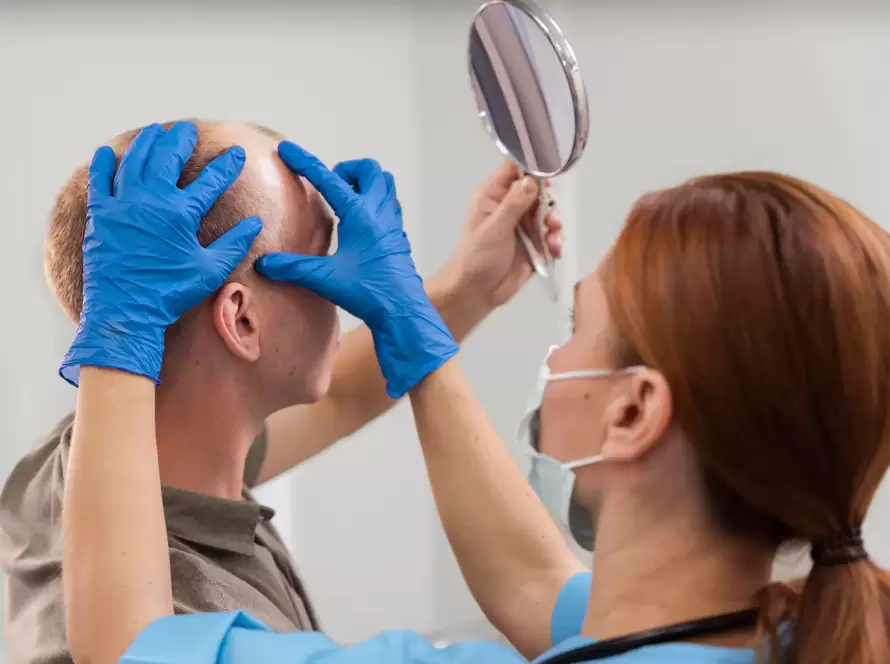

Why the Hairline Is Everything?
Think about the last time you looked at someone and thought their hair transplant was
obvious. Chances are, it wasn’t the density behind the hairline that gave it away. It was the hairline itself — too straight, too low, too uniform. That’s what the eye catches first. Your hairline frames your entire face. It defines how people see you in conversation, in photos, and in the mirror. So when we talk about what makes a natural-looking hair transplant, we’re really talking about one thing above everything else: getting the hairline right.
And getting it right is genuinely difficult. It isn’t just a matter of drawing a line and filling it in. It
requires a combination of surgical skill, aesthetic judgement, and a deep understanding of
how hair actually grows — and how it will continue to behave over time. Here’s exactly how it’s done.
What Actually Makes a Hairline Look Unnatural?
Before diving into technique, it’s worth understanding why hairlines fail — because it changes how you think about everything that follows.
Most people can spot a hair transplant from across the room, but they can’t always articulate why. Usually it comes down to one of two things:
- The hairline is too straight. No natural hairline in history was ever a perfect horizontal line. Real hairlines have subtle irregularities — slight undulations, variation in height, gentle recession at the temples. When a hairline is perfectly symmetrical and ruler-straight, the brain reads it as artificial, even if it can’t explain why.
- The hairline is set too low. A low hairline can look striking at 28. At 48, with the face having aged around it and the rest of the hair having thinned further, it can look completely out of place. A hairline that ignores the future is a hairline that creates problems.
Natural hairline design in a hair transplant solves both of these — deliberately, technically, and with real forethought.
Step 1: Custom Hairline Design — Your Face, Not a Formula
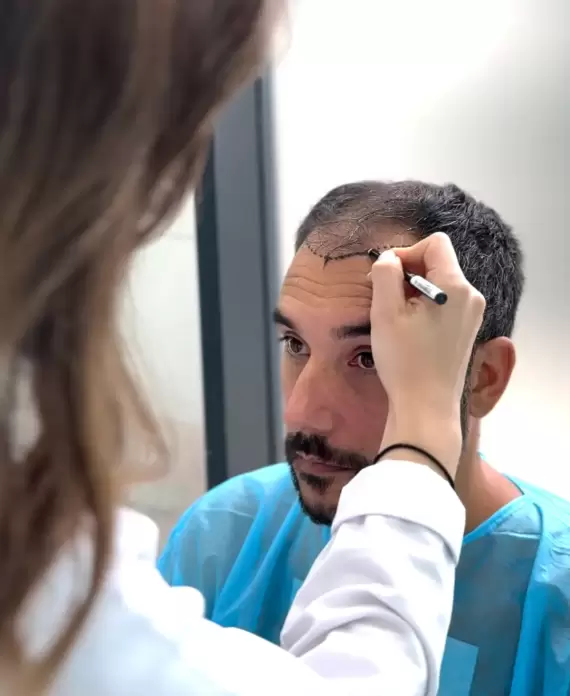
The first and most important stage has nothing to do with surgery. It happens in the consultation room, with the surgeon studying your face before anything is marked.
This is where FUE hairline design begins in earnest — and where the difference between a good result and a great one is often decided.
Facial Proportions as a Starting Point (Not a Rule)
Experienced surgeons reference the classical facial thirds — the rough visual division between your hairline and brow, brow and nose, nose and chin. It’s a useful proportion guide that helps establish where a hairline could sit harmoniously.
But it’s a guide, not a template. Your bone structure, forehead width, skin tone, and personal aesthetic preferences all shape the decision. A hairline designed from proportion alone, without accounting for the individual in front of you, will always look slightly off.
Reading Facial Movement
Here’s something many patients don’t know happens: during hairline design, a skilled surgeon will ask you to raise your eyebrows. Fully. And make natural expressions.
This isn’t incidental — it’s essential. The hairline is a moving part of your face, not a static one. If grafts are placed in skin that creases when you raise your brow, they’ll sit in folds, look unnatural in expression, and may also be at greater risk of poor survival.
By mapping the uppermost stable forehead line during full expression, the surgeon can identify the true natural boundary — and that’s where the hairline belongs.
Designing Around Your Future, Not Just Today
This is perhaps the most overlooked part of hair transplant hairline design, and also the most important.
Hair loss doesn’t stop after a transplant. If you’re 32, there’s a very real possibility that the hair behind your restored hairline will continue to thin over the next decade. A hairline placed without accounting for this progression can create a situation where you have a sharp, restored front but visibly thinning mid-scalp — which can actually draw more attention to hair loss than the original recession did.
A properly designed natural hairline hair transplant is one built to age gracefully. The surgeon considers your current Norwood scale classification, your family history of hair loss, and the likely trajectory of your androgenetic alopecia before a single mark is made.
Step 2: The Single-to-Multiple Graft Technique — Building a Soft Transition
Once the design is agreed and marked, the next decision is equally critical: which grafts go where.
Hair follicles are harvested from the donor area as follicular units — natural bundles of one, two, three, or sometimes four hairs. In FUE hair transplant procedures, these are extracted individually using a micro-punch tool. Each graft type plays a different role in the final result.
The Front Edge: Single Hair Follicular Units
Walk up to someone with a full head of natural hair and look closely at their hairline. You’ll notice something: it doesn’t start with thick, dense hair. It begins with fine, almost wispy individual strands that gradually build into the main body of hair.
This is why the front row of any well-executed hair transplant using a natural hairline technique always uses single-hair grafts. Not two-hair grafts. Not three. Single hairs, placed one by one, to create what surgeons call the transition zone — a soft, gradual blending from forehead to scalp.
It’s this transition zone that the eye reads as real. Without it, the hairline has an abrupt, plug-like quality that immediately signals a transplant — the classic look of outdated or poorly performed procedures.
Behind the Front: Progressive Graft Density
Once that soft leading edge is established, the strategy shifts. Moving back from the hairline, the surgeon introduces two-hair grafts, then three-hair grafts — in a deliberate, progressive sequence that mirrors how natural hair density actually builds across the scalp.
This isn’t random placement. It requires careful pre-planning — the surgeon maps out
exactly how many single, double, and triple grafts are needed, in which positions, before a
single incision is made. The result is a hairline that flows from delicate to full without any
visible jump between zones.
Step 3: Zig-Zag Placement — Why Straight Lines Are the Enemy
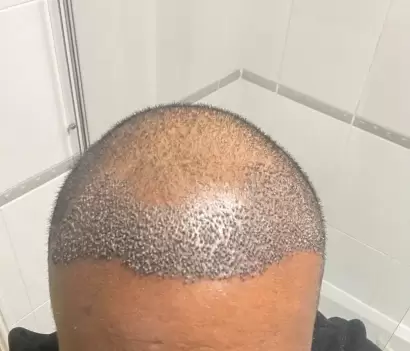
Even with perfect graft selection and a beautifully designed hairline, there’s one more layer of technique that determines whether the result looks real: the pattern in which each graft is placed.
Why a Straight Row Always Fails
Imagine placing every single graft at exactly the same depth and height across the hairline — a perfect horizontal row. Even with soft single-hair grafts at the front, the result still reads as artificial. That’s because natural hair doesn’t grow in rows. Individual hairs at the hairline
are offset from one another, sitting at slightly different heights and positions, with naturally irregular spacing.
When grafts are placed in a rigid line, light reflects differently off the scalp at the hairline edge — creating a visible boundary that even untrained eyes will notice.
Deliberate, Controlled Irregularity
To counter this, skilled surgeons use what is widely called zig-zag or irregular placement. Each graft is placed at a slightly different height from its neighbours — deliberately, not randomly — creating a pattern that mimics the natural variation of a real hairline.
This is intentional artistry applied at a microscopic level. The surgeon knows exactly where every graft is going, but builds in controlled irregularity so that no consistent line ever forms. Seen under direct light from any angle, the hairline edge catches light the same way a natural hairline does — with no visible boundary.
Angle and Direction: The Detail That Often Gets Missed Position alone isn’t enough. The angle at which each graft is placed matters enormously.
Hairs at the front of the hairline typically grow at a very acute angle — nearly parallel to the scalp surface. Move back into the mid-scalp, and that angle gradually steepens. If grafts at the hairline are placed at the wrong angle — even slightly too upright — the emerging hairs
will grow outward or upward instead of lying flat. The result is a hairline that looks artificial even if every other element is correct.
In skilled hands, every incision in the hairline zone is made at precisely the right angle and direction for that specific position. It is painstaking, exacting work — and it’s what separates truly natural results from merely adequate ones.
The Role of Expertise: Why This Cannot Be Rushed or Compromised
Everything above — the facial assessment, the design mapping, the graft distribution planning, the zig-zag placement, the precise angulation — is the product of genuine specialist expertise. It cannot be templated, automated, or rushed.
At our clinic, hairline design and placement is carried out by our expert medical team — specialists with dedicated experience in hair restoration who understand that the hairline zone demands an entirely different level of precision compared to routine density work elsewhere on the scalp.
This is a meaningful distinction when comparing clinics. Some clinics rely on less experienced staff for placement once extraction is complete. At the hairline — where every millimetre of positioning and every degree of angle has a direct impact on the result — the level of expertise performing that placement is everything.
When evaluating your options for a hair transplant in the UK, it’s worth asking directly: what is the experience level of the team performing hairline placement, and what is their specific background in hair restoration?
Ready to Regain Your Hairline?
If you’re considering a hair transplant UK procedure, your hairline design is the single most important factor in achieving natural results.
At our clinic, we specialise in natural hairline hair transplant techniques using advanced FUE hairline UK methods, ensuring every patient receives a personalised and future-proof design.
Book your free consultation today and discover what your ideal hairline could look like.