

Is a hair transplant permanent? Often the transplanted hair lasts for many years, but nobody can honestly promise it will last for life, and a transplant does not stop your remaining hair from thinning. That second point is why results can change over time, even after a successful procedure.
At Clinic Center, a doctor-led hair transplant clinic with consultations in London and by video, we think you should hear this before you book. This guide covers how long a hair transplant lasts, what to expect at 10 and 20 years, and when a second procedure might come up.
Key takeaways
- Transplanted hair is taken from an area less affected by hair loss, and the International Society of Hair Restoration Surgery (ISHRS) describes grafts as permanent “in most cases”, not in all.
- In one study of 112 men, 102 showed some reduction in transplanted hair density between one and four years after surgery.
- Native hair around the transplant can keep thinning, so a transplant done today may look different in later years.
- Donor hair is limited, so future hair loss should be part of the plan from the first consultation.
Is a hair transplant permanent?
A hair transplant is long-lasting for many men, but permanent is too strong a promise. The ISHRS says that transplanted grafts are “in most cases permanent”, while the authors of a four-year study concluded that grafts “may not last permanently for all the subjects”.
Those two statements fit together. Moved hair often keeps growing, yet some men will see it thin, and the hair around it can change too. If you are considering our hair transplant clinic or any other, treat “permanent” as a question to ask, not a guarantee.
Why can transplanted hair outlast your native hair?
Transplanted hair can outlast native hair because it usually comes from the donor area, typically the back of the head, where hair is less affected by male pattern baldness. Male pattern baldness is also called androgenetic alopecia. It is inherited and progressive, and it is driven mainly by a hormone called dihydrotestosterone (DHT).
Hair in the donor area contains DHT-resistant follicles. The ISHRS explains that these hairs keep their donor characteristics after being moved, a principle known as donor dominance. Each graft is usually a follicular unit, the small natural grouping of hairs that is moved as one piece.
Native hair has no such protection. It stays exposed to the same genetics and hormones that caused the original loss, which is why the NHS warns that your hair might continue to thin around the transplant.
How long does a hair transplant last?
No fixed lifespan applies to every patient, because how long a hair transplant lasts depends on the grafts, the donor hair and your wider pattern of hair loss. The table below separates what is measured from what is expected.
| Time after surgery | What to expect | Basis |
|---|---|---|
| A few weeks | Transplanted hair often falls out | NHS guidance |
| About 4 months | New hair usually appears | NHS guidance |
| 10 to 18 months | Full results should be visible | NHS guidance |
| 4 years | Most men in one study showed some loss of transplanted density | One retrospective study |
| 10 years | Native hair loss may have progressed around the grafts | Expected, not measured |
| 20 years | Native loss and ageing may affect the overall look | Expected, not measured |
The timings in the first three rows come from the NHS hair transplant page. For a closer look at the first year, see our hair transplant growth timeline.
What did the four-year study find?
A study published in the Journal of Cutaneous and Aesthetic Surgery looked back at 112 men with Norwood grade 4 or higher hair loss, four years after one strip (FUT) procedure. Compared with their one-year photographs, 10 men showed no change in transplanted density, 31 a slight reduction, 62 a moderate reduction and nine a great reduction.
These results need care. The study had no control group, came from one centre in India, and graded photographs by eye instead of counting hairs. It also looked at FUT, so it does not tell you how Sapphire FUE results compare over the same period.
What happens 10 years after a hair transplant?
Ten years after a hair transplant, the grafted area may still be growing hair, but the overall result depends heavily on what your native hair has done in that time. A transplanted hairline can remain in place while hair behind it thins, which can leave a less natural pattern if the design did not allow for this.
Reliable 10-year data is hard to find, and the study above stopped at four years. Be cautious of any exact 10-year figure offered without a named source. The NHS says your surgeon should plan the design so that it looks natural over time, which is worth discussing with us in detail, along with how a natural hairline is designed.
What happens 20 years after a hair transplant?
Twenty years after a hair transplant, expect your hair to look older as you do, with the final appearance shaped by age, genetics and any further treatment. Measured 20-year outcomes are not something we can quote, so this answer is a reasoned expectation, not a promise.
The ISHRS describes androgenetic alopecia as progressive, and says that further loss may mean additional transplants to fill gaps. A man who has a transplant at 30 therefore needs to think about how he may want his hair to look at 50, and whether enough donor hair will remain.
Will I need a second hair transplant?
You might need a second hair transplant, particularly if you are young or your hair loss is still progressing. The ISHRS is direct on this: “you should never expect one surgery to be enough to keep you covered for a lifetime”. It names continued androgenetic alopecia as the number one reason for a further procedure.
A second procedure can also follow poor growth, once any scalp or medical cause has been treated or ruled out. Large areas may need more than one session from the start, as the NHS notes.
Your options depend on your donor area, which is a limited and non-renewable resource. The ISHRS says a doctor may recommend fewer grafts than the maximum possible, so that some donor hair is kept back for later.
Example: a 27-year-old with a receding hairline and a family history of baldness asks for the lowest, densest hairline possible. His pattern may not be stable yet, as the ISHRS points out for younger patients, so using a large share of his donor hair now could limit his choices at 40. A more conservative plan could suit him better. A doctor would need to assess his scalp in person.
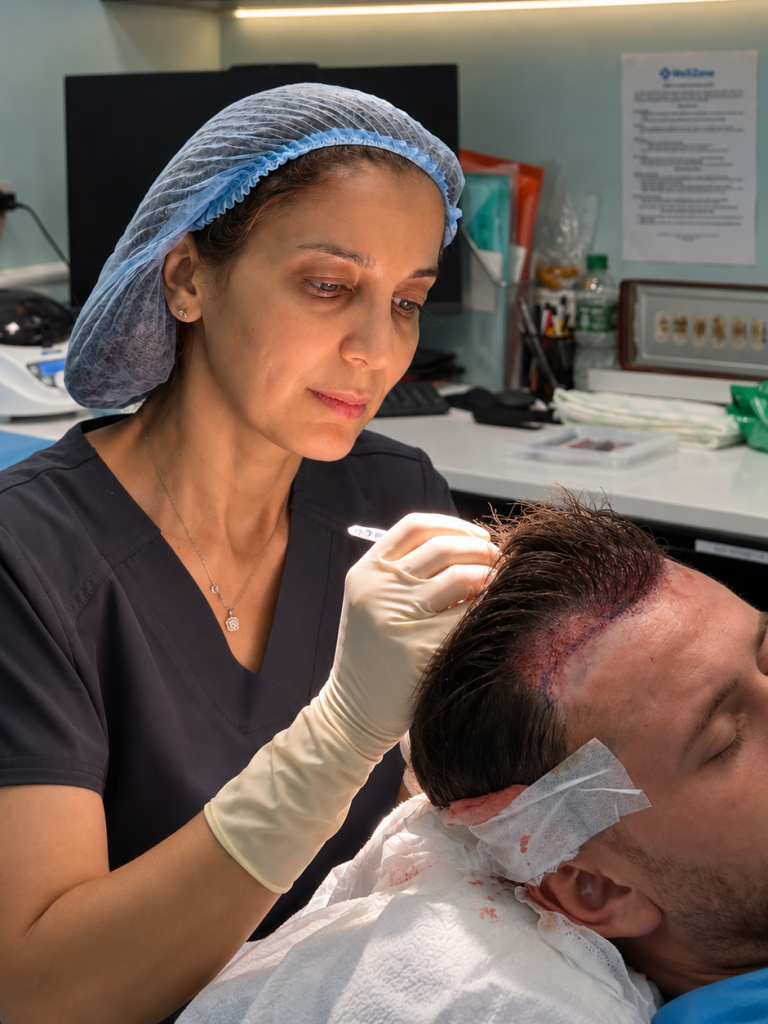
Dr Songul, hair transplant surgeon at Clinic Center London, said: “A successful hair transplant starts with careful planning. Hair loss is ongoing, so existing native hair may thin and another transplant may be needed in future. The donor area is precious, because follicles do not grow back once extracted, so we are careful how many grafts we take and preserve donor hair for future procedures. A good hair transplant is not simply about creating a fuller head of hair today. It’s about achieving a natural, balanced result while thinking about the patient’s long-term needs.”
We follow patients up for 12 months after the procedure, and our aftercare support stays free and unlimited after that.
Can transplanted hair fall out?
Yes, transplanted hair can fall out, and the timing matters. Shedding in the first few weeks is expected, because the NHS says transplanted hair often falls out before new hair appears at around four months.
Later loss is different. The NHS also notes a small risk that the transplant will not take, and the four-year study above recorded density loss in most of the men it followed. If hair thins or falls out suddenly years later, ask a doctor to check for another cause rather than assuming the transplant is to blame.
What does graft survival mean?
Graft survival is the share of transplanted grafts that take and go on to grow hair. It describes how well the procedure took, not how the wider result ages, so a high early figure does not answer the long-term question.
Survival percentages are often quoted online with no source. Ask any clinic how many patients its figure covers, how hairs were counted, and how long after surgery.
Do I need to keep taking medication after a hair transplant?
A transplant does not automatically mean taking medication afterwards, and whether medication suits you is a decision to make with a doctor. The ISHRS says non-surgical treatments should be considered first or alongside surgery, with the aim of stabilising hair loss.
Finasteride 1mg is a prescription-only medicine. Its product information says that if treatment stops, the effects begin to reverse by six months and return to baseline by nine to 12 months. In the four-year study above, the influence of minoxidil and finasteride on the longevity of transplanted hair was not statistically significant.
Finasteride also carries safety warnings. In May 2026, the MHRA strengthened its warnings, which cover sexual dysfunction and mood changes. Anyone who develops depression or suicidal thoughts while taking it should stop treatment and seek medical advice. Speak to your GP or another doctor before starting or stopping any hair loss medicine.
What should you ask before booking a hair transplant?
The most useful questions test how a clinic plans for the long term:
- Is my hair loss likely to progress? Ask how your age and family history affect the plan.
- How much donor hair do I have? Ask how many grafts could remain for later.
- Does the hairline allow for future loss? Ask how it would look if the hair behind it thins.
- Should I consider medical treatment? Ask for the benefits and side effects from a doctor.
- Who carries out the surgery? The NHS advises finding a qualified, experienced surgeon, and says all doctors must be registered with the General Medical Council (GMC).
You can raise all of this at a free consultation, in person in London or by video. Dr Songul Kaloglu, one of our hair transplant doctors, is GMC registered, and you can view our Bermondsey clinic on the CQC website.
Frequently asked questions
Does a hair transplant stop hair loss?
No, a hair transplant does not stop hair loss. It moves existing hair to thinning areas, while your native hair remains exposed to the causes of androgenetic alopecia. Further thinning can continue around the transplant, so your plan should allow for it. A doctor can explain whether medical treatment is worth considering in your case.
Does the donor area grow back?
No, follicles extracted from the donor area do not grow back. Donor hair is a limited supply, and overharvesting can cause visible thinning and reduce your options for a later procedure. This is why the number of grafts removed should reflect your donor density and likely future hair loss, not only your current goal.
Do FUE and DHI transplants last longer than FUT?
The four-year study discussed in this guide looked only at FUT, so it cannot show whether FUE or DHI transplants last longer. Hair for all three methods is normally taken from the donor area. Ask your doctor what long-term evidence exists for the technique suggested for you, and how it was measured.
Can I get a hair transplant on the NHS?
No, a hair transplant is not available on the NHS because it is classed as cosmetic surgery. The cost depends on the extent of hair loss, the type of procedure and the clinic, so see our hair transplant prices or ask for a written total at your consultation. Allow for the possibility of a second procedure when you budget.
Deciding whether a hair transplant is right for you
Is a hair transplant permanent? It can be long-lasting, but it comes with no lifetime promise, and your native hair will carry on following its own course. The right question is whether the plan still makes sense if your hair loss progresses.
If you want a clear answer for your own scalp, speak to our team at Clinic Center. We can talk through your treatment plan and give you a medical assessment at a free London or video consultation.

